
Whyyour gripdies.
How grip is made — and why the wrong care destroys it fast.
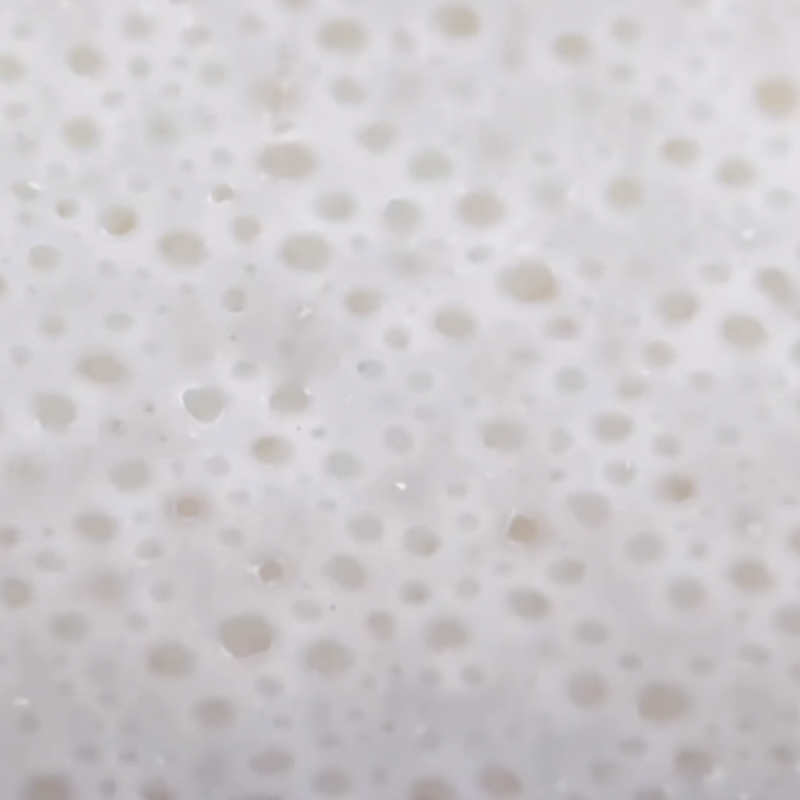
A sponge,your glue.
The palm of a goalkeeper glove is made from natural latex — harvested from the sap of the rubber tree, with an open, microscopic cell structure. Physically, it's a sponge with billions of tiny pores. When the ball hits, the material compresses, air escapes, and a negative pressure builds up inside the pores: the capillary effect.
The ball doesn't stick. It gets suctioned in. Each one of those microscopic cavities acts like a miniature suction cup. Thousands of them, per palm.
Without open pores
no suction.
Without vacuum no grip."
Two conditions need to be met for this effect to work: the latex needs a slight base level of moisture, and the pores need to be clear — free from dirt, dust, and especially sweat residue.
Regular handwashing doesn't reach deep into the microscopic cell structure. Cleaning in the GloveBag, on the other hand, flushes the pores completely clear and restores the grip.
Zoom in.Grip is physics.
Three levels, one realization


Sweat cutsfrom the inside.
During training, sweat settles deep into the latex. It contains salts, fats and acids that work their way into the pores. If your gloves sit unwashed in your bag, something happens that hardly anyone has on their radar:
The salts crystallise as they dry. They form microscopic, sharp-edged structures. The next time you play, these cut open the latex’s cell walls from the inside. The material turns brittle, the palm loses its elasticity. Cracks appear.
We see it in training every day: gloves that still look flawless on the outside, but whose grip foam is already dead. The keeper swaps gloves, even though with the right care they’d have lasted twice as long¹.
¹ Internal test with GloveBag prototypes (2024). Results depend on the glove, the latex and your training load.
Hand wash only isbetter than nothing.But not great.
For a long time, hand washing was the standard: lukewarm water, specialist cleaner, gentle massaging. Better than nothing — but with three systematic problems.
- Problem 01SuperficialDirt gets massaged into the pores over time instead of being rinsed out.
- Problem 02MechanicalWringing permanently deforms the cell structure.
- Problem 03DryingHeat, sun, hair dryer — latex shrinks, cracks, crumbles.
Machine washing with GloveBag eliminates all three problems at once. Over 1,000 microfibre fingers inside the bag clean more gently than a human hand; the thick fabric protects the foam during the spin cycle; a pH-neutral specialist detergent like GloveWash dissolves salts without attacking the plasticisers in the latex.

